


podcast

Most entrepreneurs have done the values exercise. You know the one – you sit down during your brand strategy session, brainstorm a list of words that feel right, pick your top five, and pop them on your website. Job done. Values: ticked.
But here's what we don't talk about enough: what happens after that?
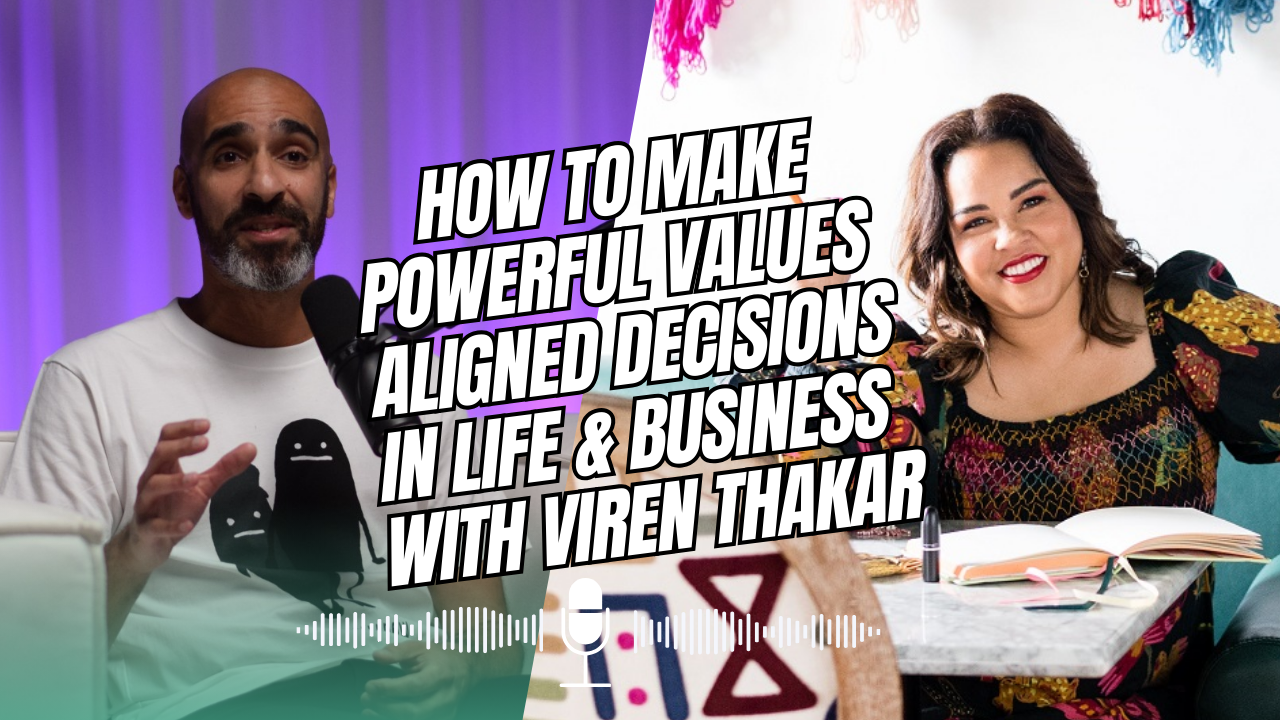
In a recent episode of the Brand Builders Lab podcast, I sat down with my long-time friend and values expert Viren Thakar — founder of In The Game and a coach who works with organisations and individuals to do the deep, practical work of values alignment. What followed was one of the richest conversations I've had on this podcast.
Here's what we unpacked.
Your Values Aren't a Branding Exercise. They're a Operating System.
Viren's whole philosophy is that values aren't static words — they're living constructs that should shape the way you work, the decisions you make, the clients you take on, and the products you build.
“I think when we just think of the word, it's just a shortcut to the construct,” he says. “It's so important to interrogate that and go — what does this actually mean to me?”
That's the piece most of us skip. We pick the word freedom or fun or growth and leave it there. But what does freedom actually look like in your day? What does fun feel like in your delivery? What does growth require of your weekly schedule? Until you answer those questions, the values are just decoration.
How to Actually Identify Your Values (Beyond the Word List)
Viren offers a beautifully simple place to start: look back over the last month and write down everything — big or small — that brought you meaning and satisfaction. Then look for the patterns. What concepts connect those experiences? That's where your values live.
But there's another method I love even more: look at your irrational reactions.
“When have I irrationally reacted at something? That reaction often points to a values conflict.”
Viren's example? His wife suggested a shared calendar. His response was wildly out of proportion — until he realised it was because he deeply values freedom, and the idea of things appearing in his schedule without his say felt like a direct threat to that. Once he understood why he reacted that way, he could make a more grounded (and adult) decision about the calendar situation.
Your biggest emotional responses — the ones that seem disproportionate — are often your values talking.
Designing Your Week Around What You Actually Value
One of the most practical things Viren does is take his five values and ask: how do I create time and space for each of these in a given week?
Take his value of freedom. For him, that means 95% of his workdays don't start before 10am. He doesn't take client-facing calls in the mornings. Instead, he does puzzles, spends time with his kids, and eases into the day. That's not laziness — it's intentional design.
His value of fun? It shows up in how he delivers his services — using play-based approaches like Lego, games, and drawing to help teams have deeper conversations about culture. He doesn't just believe in fun; he's built an entire methodology around it.
For growth, he tries a new tool every single week. Not from a place of FOMO, but from genuine curiosity and love of learning. He might use it to try a piece of client work, or just play around with it for an hour and move on.
The key isn't the specific ritual — it's that each one is deliberately connected back to a value.
“I'm always looking to bring a new tool in, at least one per week. Part of that is also a lot of fun — the novelty of it.”
The Check-In That Keeps You Aligned
Knowing your values is one thing. Staying aligned with them in the chaos of running a business is another.
Viren's approach is a regular check-in where he scores himself from 1–5 on how well he's living each value. When something scores low, he gets curious about why.
Recently, fun was sitting at a three. When he dug into it, he realised mindless scrolling had crept in and was crowding out more meaningful activities. His solution wasn't a productivity overhaul — it was creating a list of “high dopamine activities” and making sure a few of them made it into each week.
“The phone is an experience blocker. I think it's a values blocker. We use it and it means we're not spending our time in a values-aligned way.”
Values Alignment Doesn't Mean Ignoring the Market
Here's something Viren is honest about, and it's important: values alone don't build a business.
He learned this the hard way when he got very excited about games — designing and selling games for use in HR and people and culture work. He was completely values-aligned. The market, however, wasn't buying what he thought he was selling.
“People aren't buying play from me. They're buying culture change. Play is the mechanism.”
The lesson? Your values should shape how you deliver. But you still need to understand what the market actually wants to buy. When those two things come together — a real market need delivered through your values-aligned approach — that's where the magic happens.
The Profitable-but-Hollow Project Problem
We've all been there. The client or project that looks great on paper — good money, straightforward scope — but leaves you feeling flat afterwards. That hollow feeling? Almost always a values conflict.
Viren's take: it's okay to take on work that isn't fully values-aligned, as long as you do it intentionally.
“I've definitely done work that's not super values-aligned because the business needed a cash injection. But I knew I was doing that. It was ring-fenced and deliberate.”
The danger is when we keep making those decisions without realising it — chasing the metrics, following the external noise about what a “successful” business looks like, and slowly drifting away from what actually matters to us. That's when we end up in the same place as the senior leader who has the house, the salary, the promotions — and still feels empty.
Your Values Attract (and Repel) the Right People
Here's the part that connects directly to brand building: when you infuse your values into how you show up — your content, your delivery, your energy, your opinions — you naturally attract people who are aligned with those values.
Viren doesn't advertise “I use play.” He just is playful. His videos have a certain energy. His events combine house music with HR. His business is called In The Game. By the time someone reaches out, they're already sold — because everything they've seen reflects who he is.
“What you put out there will attract the right kinds of clients. Yes, it'll attract some people and repel others — and I've got to be happy with that.”
One of Viren's informal filters for new clients? Whether he laughs in the first meeting. Not gut-busting comedy — just a lightness, a willingness to find something absurd in life. If it's not there, the project probably won't feel good either.
Purpose vs Values: They're Not the Same Thing
One distinction Viren makes that I think is really valuable: values are internal alignment, and purpose is the external expression of that alignment.
“Your values, your strengths, the things you know — how do they combine together to help other people?”
And here's the part I love: he doesn't believe you have one purpose. You have a purpose for every group you serve — your clients, your family, your friendship groups. Each is a different expression of the same underlying values.
For founders, the question becomes: how does your unique combination of values, strengths, and knowledge allow you to serve your specific audience in a way no one else quite can?
The Simple Question to Start With This Week
If all of this feels like a lot, here's where Viren suggests beginning: pull up your existing values (or do the month-in-review exercise to find them), and then ask yourself one question for each one.
On a scale of 1–5, how well am I currently living in alignment with this value?
Where the score is low — get curious. What's getting in the way? What's one small ritual or switch you could make this week to move the needle?
It doesn't have to be a big overhaul. It could be swapping the morning scroll for a crossword. It could be moving your first meeting to 10am. It could be brainstorming what your business would look like if you went completely, ridiculously over the top with one of your values.
As Viren puts it: “It doesn't need to always be big things. A lot of it can be little daily rituals just to bring your values to life.”
Connect with Viren Thakar:
- LinkedIn: Viren Thakar
- Podcast: The Values Lab
- Product: The Values Map — for founders and portfolio professionals who want to articulate and implement their values in day-to-day life
Loved this episode? Share it with a founder friend who's been feeling a little hollow lately — they probably need this conversation.
Why Your Values Should Run Your Business (Not Just Sit on Your About Page)
FREE MASTERCLASS - GO FROM FEELING MESSY TO MAGNETIC

Feeling busy but not clear? Productive but not confident?
This is one of my favourite workshop and I know you're going to love it!
In this free Messy to Magnetic masterclass, I’ll show you how to clean up your business, strengthen your identity as a leader, and create clarity that actually moves the needle.
You’ll learn how to:
✨ Shift your mindset and identity so you stop second-guessing yourself
✨ Build a simple, streamlined business that supports growth
✨ Know exactly what to focus on daily, weekly, and monthly
✨ Create momentum without burnout or overwhelm