


podcast


Did you know that leads converted by your personal brand will actually convert seven times more frequently? That stat's from DreamBox, and honestly, it blew my mind when I first saw it.

Here's what I see all the time: really experienced women who are absolute guns at what they do, but they're not capitalizing on their expertise and knowledge online. And I reckon there are four key reasons why that's happening.

If you're an experienced subject matter expert who's been doing what you do for years, but you're not showing up online, not creating your personal brand, not capitalizing on it so it can convert seven times faster than anything else—you're missing such an amazing opportunity.

Before we dive in, here's another stat I absolutely love: people pay up to 13.57 times more for those considered elite experts. That's from Hinge Marketing. So not only can you convert faster and more with a personal brand, you can get paid significantly more as well.

Let's talk about the key things you might need to overcome and shift your thinking around if you want your personal brand to start doing the heavy lifting in your business for you.

If we've not met, I'm Suz Chadwick. I'm a personal brand and business coach. I've had my business for over 10 years, and before that, I ran a brand agency where I worked with leaders to help them build their personal brands in the corporate space. I currently work with multi-six and seven-figure business owners who have amazing expertise but may not have what I call the micro media company behind them driving their sales, their reputation, and their opportunities. That's such a waste if you're not doing it.

The Curse of Knowledge Is Holding You Back

The first thing I've experienced myself and see with my clients constantly is the curse of knowledge. You think everybody knows what you know. You think the most basic information you have is just available to everyone, and I want to remind you that you have your knowledge and expertise because of your hard-earned experience.

That didn't just come to you. You worked over the last 5, 10, 15, 20 years to gain that experience, to gain that insight, to gain that knowledge. And we're not just talking about sharing tips and tricks with people.

We're talking about your insights into your industry, stories you can share about how you learned these things, what you know about your industry, your clients, and what's happening in your marketplace.

This is actually a blind spot you have. And can I just say—you're not alone. Don't you love it when you see something online that's gone viral, got huge amounts of attention, people are talking about it, and you look at it and think, “That is basic biscuits. I could have shared that five or 10 years ago”?

But here's the thing: there are new people coming into the market all the time. There are people who do not know your area of expertise or your industry, and so sharing from the beginning—the things you help people do, the transformation you're getting them—matters.

I want you to take a step back and ask yourself: if I was educating somebody on how to get to where I am, or even to get to level one if I'm at level four, what would I need to tell them?

A really great way to do this is something I talk about with my clients—mapping your method. I've been a frameworks-method-blueprint-roadmap type of girl for a long time because I come from a consulting background, and that's how we did things.

But when you can actually sit down and say, “Okay, what's the transformation I want to get my client?” and then start from the beginning—if I was taking them to level one, what would they need to know? What's the first thing they need to know?

If I'm talking about personal branding, maybe I need to educate my client on what a personal brand is, what that could look like for them, why it even matters. Those stats I just shared with you—if you have a personal brand, it converts seven times more, you get paid 13% more—so they understand why this is even something they should care about.

When you start to map out your method and the steps somebody takes to get to different levels, it can really help you have a clear understanding of what kind of content you might want to share with your audience. You won't get stuck in the curse of knowledge or take for granted what you know, your years of experience, your expertise.

I know it can feel really awkward sometimes speaking about something you think is so basic. But this is where you've got to realise—especially when you understand who you're speaking to—what level of person are you speaking to? Are they a beginner? Are they more advanced? And what is it that they need to know?

When you know who you're speaking to, you can start to design what kind of content is going to be relevant for them as well.

One of the things I always tell my clients to do is actually map it out visually and stick it somewhere so that whenever you're thinking, “What do I talk about? How do I share this?” you've literally got it sitting right in front of you. You know what you can be talking about today, or if you're batching and planning, you could be taking them through a series or sequence of information.

Let them know who this is for. If you're just starting out and you don't have a personal brand, then this is where you need to start, this is why it's so important, and these are the benefits of it.

If I'm speaking to somebody who's a bit more advanced and they understand personal branding, then I might start talking to them about the systems they put in place when it comes to their personal brand—the micro media company they need to start building so they've got this system working for them, a content authority engine working for them.

It depends on who I'm speaking to as to what I'll be talking about.

That's the first thing—really identifying if you have the curse of knowledge, if you assume everybody knows what you know. I think it's pretty common in people who are very experienced at what they do because you've been sat in it for so long that you're like, “I'm sure everybody already knows this.”

The Fear of Looking Like a Beginner Again

The second thing I see with experienced subject matter experts is the fear of failure and looking like a beginner again. You're so great at what you do, but maybe you haven't done video before. Maybe you haven't needed to write before. Maybe you haven't needed to show up and build a brand before.

When you're really good at what you do and it feels like breathing every day, having to now learn a new skill and get uncomfortable—because that is what it takes—means you have to see yourself as a beginner again.

That is one of the most awkward things you probably have to deal with. It's like, “I've spent so long getting great at what I do, why do I now have to be a beginner at something else?”

I think knowing why you're doing it, what the benefit is, what the goal and outcome are—why am I creating content? Because I want to start building my brand so it converts more, so I get paid more, so I attract more of the types of people I know I can work with, and I'm becoming more magnetic rather than having to go out and get people—that's what you need to be thinking about.

You have to have a really solid why around starting from the beginning to learn a new skill to be able to communicate your value. And as I'm recording this in 2026, communicating your value is one of the most valuable skills you can have. Being able to talk about what you do, having a super clear message, building your confidence to do that.

The thing is, because you already know what you're talking about, it's really just getting comfortable delivering that information in a different way, because you're probably delivering that information to your clients daily. So it's converting the way you're speaking about what you already know.

I say to my clients: if you can find a way to get in flow where maybe you are in your client energy—which means when I get on a Zoom and I'm speaking to my clients, I go into autopilot mode. I know exactly what I'm helping them with. When they're asking me questions, I know the answer, or we work it out together. You are in flow. You know what you're doing.

Working out the best way for you to get in flow when you're creating is something to work towards, because then it's just going to become like second nature again.

I see a lot of people who do low-effort content as well, where there's not a lot of editing, not a lot of slides or information they're putting up on the screen. They're just speaking to the camera. And you can absolutely do that. You don't have to have a whole production team and editors and all the rest of it when you're getting started.

I think just grabbing your phone, hitting record, and starting to share what you know is a great place to start. Start from there. Record a 30-second, 60-second video sharing something you know is of value to your clients.

Don't have huge and high expectations of yourself from the beginning. And also know why you're doing it. Like, I'm here to help this particular person, and when I share this piece of information, I know it's going to connect with them. The more I do it, the more connection I'll have. The more I do it, the better I'll get at it. The more I do it, the more it becomes second nature to me, and then I don't have that fear of visibility and that fear of failure.

I totally get that you've climbed the ladder in private, and now the idea of public visibility does feel like starting over. But I think that is a mindset you've got to work on.

Every day in my calendar, from 8:30 to 9:30, I have it locked and blocked: Create content. Why? Because it's a professional practice in my business. I know why I'm doing it. I know why I'm showing up. I know why I'm creating. I know who I'm speaking to. And so it's not something that's optional.

In my business, I talk about professional practices a lot—something you just do. It's not “Am I going to do it?” It's not a negotiation. It's a set thing I know I do, like I manage my finances, like I get on my client calls, like I create content.

Whatever it is, it's something you're doing on the regular, and it's not something you're thinking, “Should I do it or should I not do it?”

Building your personal brand right now, especially if you're a coach, consultant, or creative and you're wanting to scale, wanting to have more clients coming to you rather than having to go out and get them or chase them—I think it's important for you to decide that this is going to be a professional practice for you.

The Market Has Changed (And So Has The Way People Buy)

The third thing you have to realise is that the market has changed, and so has the way people buy.

Today, decisions about who to trust happen before the call. Search results, LinkedIn posts, YouTube clips, social content—and the fact that 92% of people trust people over brands.

Even if you get referred—if somebody refers somebody to me, the first thing I'm going to do is look at their online presence. If somebody wants to be on my podcast, the first thing I'm going to do is go look at their online presence. What do they say? What's their vibe? How do they come across?

If I'm looking to work with somebody, I might Google them. I might look on Instagram. Otherwise, I might find somebody on YouTube where they're talking about the things I want to be able to do. Because all their videos are really helpful and I like the way they communicate and come across, that's already building trust for me to make a decision to buy from them.

I have 100% bought from people I've followed online. I've seen them so consistently, and the value they've provided is consistent and high quality, that I'm like, “Yeah, you are the person I'm going to buy from.”

Just understanding that if you want to have more people coming to you, this is not a nice-to-have. This is how the market works now. This is how brands are built. This is how trust is created. This is how buying decisions are made.

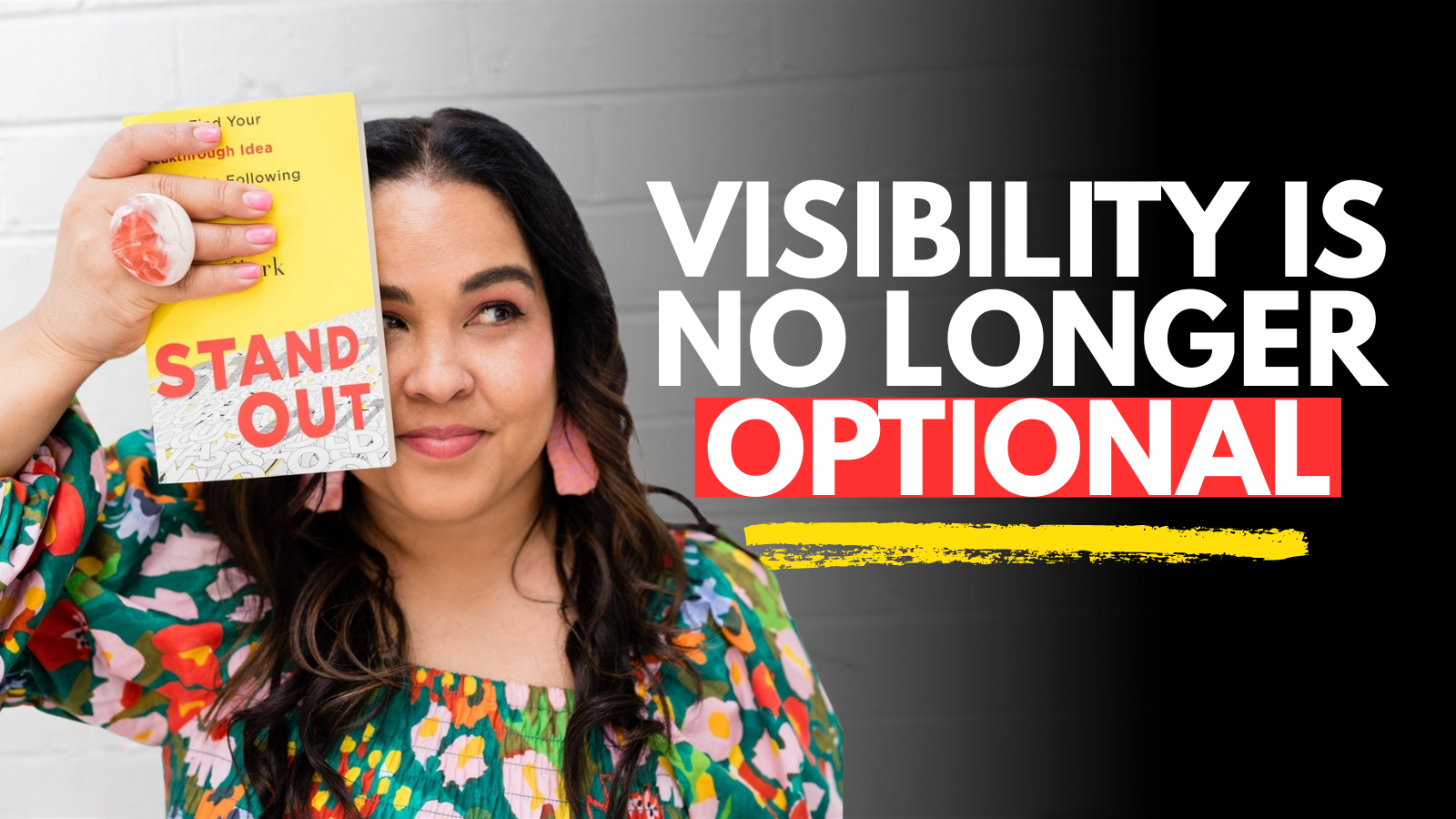
Your visibility is just not optional anymore because it directly impacts whether people hire you, invest in you, recommend you.

I had a client a while ago who came to me and just said, “I come to your content every single day. I knew months ago I was going to hire you. I knew months ago we were going to work together because I knew I needed help with this thing, and I would just come back to your content all the time. I really wasn't following many other people who talk about what you talk about. I love your personality. I love that you love fashion. I love that you're quirky and funny, and I love that you've got all this experience and expertise I know I need.”

The only way she could have known that was by following me, watching my content—behind the scenes in my stories, my YouTube videos, my podcast, my blog.

We already know people need to spend time with us to make those decisions. So if you're not creating on a regular basis and being the person they seek out, the person they come to, then you're missing an opportunity to build that trust.

Stop Letting Perfectionism Hold You Back

There are two things I want to call out here when you're building your personal brand and you're an expert in your field.

First is the perfectionism that can sometimes hold you back, like “This isn't as good as I want it to be.” I think we've also got to think about fit for purpose. What is the goal of this? Does it need to be perfect? No, it doesn't.

Nothing ever needs to be perfect because you're not going to get good at something until you start, and you are not great at it—which I know can be really hard to deal with.

The second thing is you're going to see a lot of other people potentially online, and you're going to have to manage that. I say to clients: find one or two people maybe in your niche whose content you really like. It's not about comparison; it's about learning what works.

Really see: do I like that style? Is that how I want to create? How can I learn a little bit about the way they do that without getting stuck in comparison?

I don't follow other people who do what I do. There are maybe two or three whose content I like that are way ahead of me, where I'm learning what's working for them, and then I'm looking at how that fits with me being in my flow.

Then it is time to play as well. I think sometimes we take things so seriously. The question is: how can you make this fun for you?

If you're an expert, you obviously love what you talk about. You probably have a lot to say, but maybe you're just taking it a bit too seriously, and so you're not getting it out there.

I'm running an event, so I'm speaking at the event with other people. We'll obviously capture that. I said to a friend the other day, “I would love to get the podcast into a studio for a couple of episodes. I would love to go out and speak to people.”

What would good look like to you? What would fun look like to you? How could you make this work for you in a way that feels really good? Maybe have some big goals around aspirationally what you would love to do. I would love to get into a studio and be interviewed by other people as well.

Just start thinking: how can I get my message out to more people? Yes, how can I build my brand, but what else could I do that would be really fun and exciting and a big thing for me to be able to do? That would feel really great and get me excited.

If you're constantly thinking, “Oh, this is so hard,” then it is going to be hard. But if you work out how you can do it in an easier way, then you will do it more.

This one is for my experts out there—the ones who've done the work, been around for a long time, and you're wanting to build your personal brand. These are the things to be thinking about, and I hope it inspires you to get out from behind the computer, get in front of the camera.

You've got so much to share. You've got so much knowledge to pass on to people who need what you have.

Why Experienced Women Stay Invisible Online (And What It’s Actually Costing You)

FREE MASTERCLASS - GO FROM FEELING MESSY TO MAGNETIC

Feeling busy but not clear? Productive but not confident?

This is one of my favourite workshop and I know you're going to love it!
In this free Messy to Magnetic masterclass, I’ll show you how to clean up your business, strengthen your identity as a leader, and create clarity that actually moves the needle.

You’ll learn how to:
✨ Shift your mindset and identity so you stop second-guessing yourself
✨ Build a simple, streamlined business that supports growth
✨ Know exactly what to focus on daily, weekly, and monthly
✨ Create momentum without burnout or overwhelm


ACCESS IT NOW

SITE DESIGN BY THE WHO

COPYRIGHT 2025 SUZANNE CHADWICK. ALL RIGHTS RESERVED.

POLICIES

CONTACT